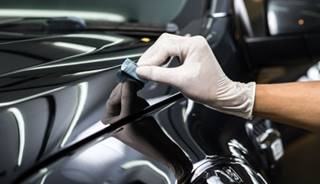


Watching a car detailer work can make the job look surprisingly simple. A machine polisher moves across the paint, a coating is applied, the surface becomes glossy, and the vehicle looks dramatically different.
But professional detailing is not simply about knowing which product to apply.
A proper professional car detailing training program teaches you how to inspect a vehicle, understand different surfaces, select the right chemicals and machines, correct paint safely, apply protection properly, troubleshoot mistakes, communicate with customers, and understand the business behind the service.
That is why genuine hands-on training is very different from learning a few detailing tricks from videos.
So, what actually happens when you step inside a professional car detailing training program?
Let’s go behind the scenes.
It Starts With Understanding the Vehicle, Not the Polishing Machine
One of the first lessons a new detailer needs to understand is that every vehicle should not be treated in exactly the same way.
Before selecting a polish, pad, coating, chemical, or machine setting, a professional should first inspect the vehicle.
Students therefore begin by learning things such as:
- Vehicle surface inspection
- Paint condition assessment
- Different paint systems
- Identifying contamination
- Understanding scratches and swirl marks
- Recognising when correction is required
- Choosing appropriate tools and chemicals
- Understanding detailing equipment
Detailers League’s advanced program starts with these fundamentals, including vehicle assessment, paint systems, clay treatment, equipment, chemicals, tools and accessories.
This foundation matters because detailing is fundamentally about making the right decision before touching the vehicle.
Someone who knows how to operate a polishing machine but cannot assess paint condition is still missing an important part of professional detailing.
You Learn Why Products Work, Not Just How to Apply Them
A common mistake among beginners is memorising processes.
They might learn:
Apply Product A, wait for a few minutes, wipe it, then apply Product B.
That may work until the paint, temperature, surface condition or product changes.
Professional training should help students understand why a particular process is being followed.
For example, students may need to understand:
- Why some chemicals are safe on one surface but not another
- Why dilution ratios matter
- Why preparation affects coating performance
- Why polishing compounds behave differently
- Why pad selection changes the correction result
- Why surface temperature matters
- Why proper decontamination is necessary before correction
- Why incorrect chemical usage can damage trims or finishes
Detailers League specifically highlights training in machinery, chemicals, detailing techniques and product usage as important parts of developing professional competence.
The aim is not simply to create someone who can repeat a procedure.
It is to create someone who can understand the situation in front of them and choose the correct process.
Hands-On Training Is Where the Real Learning Begins
You cannot become confident with detailing equipment purely by watching an instructor use it.
At some point, you have to hold the machine yourself.
That is why hands-on car detailing training is one of the most important parts of a professional program.
During practical sessions, students may work with actual vehicles and learn how to:
- Wash and decontaminate surfaces safely
- Handle machine polishers
- Select pads and compounds
- Correct paint defects
- Work around edges and body lines
- Inspect their own results
- Apply coatings
- Prepare vehicles for protection services
- Correct mistakes before vehicle delivery
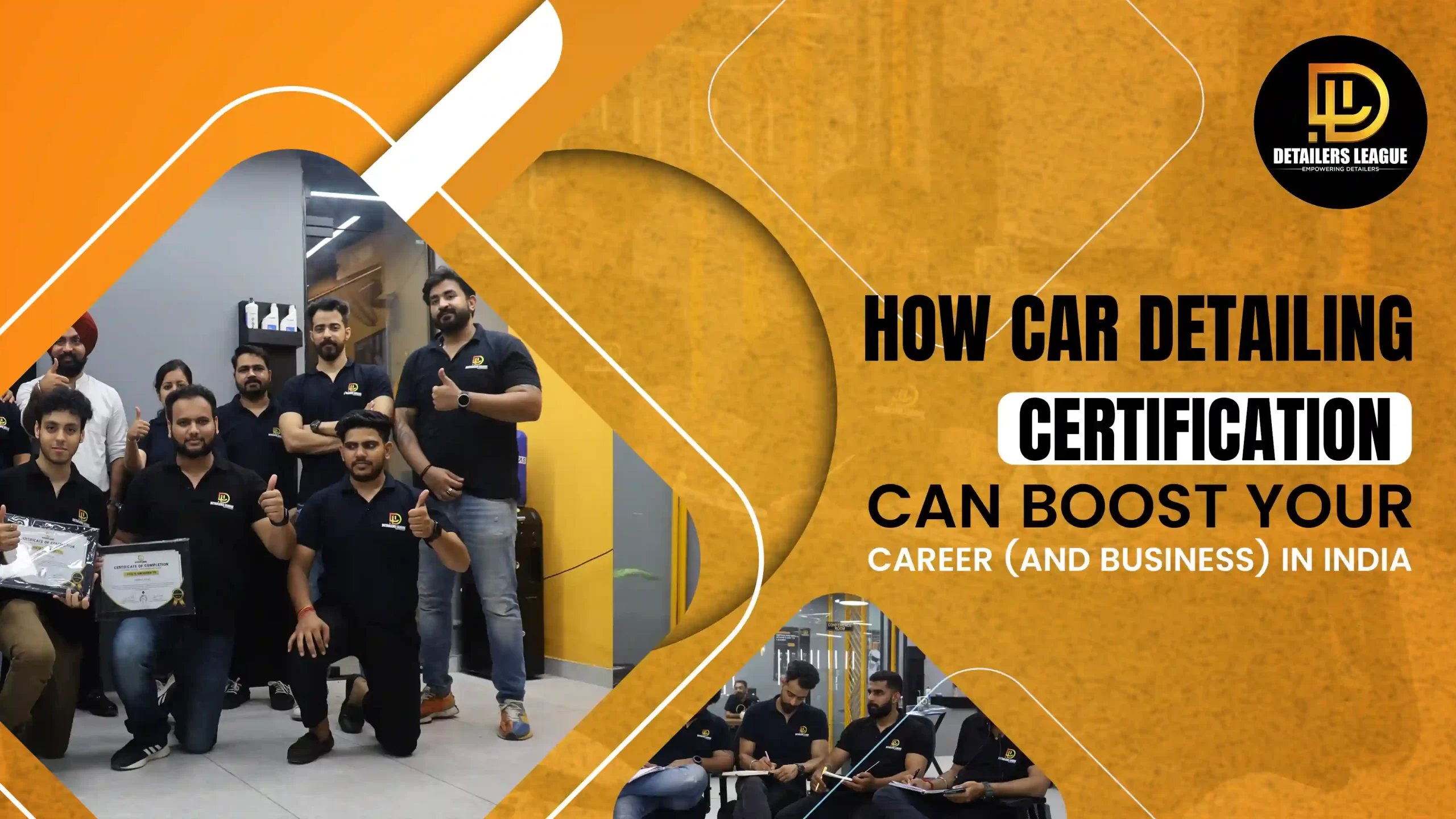
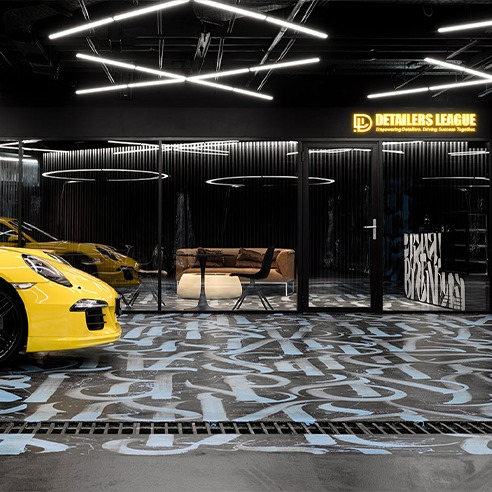
At Detailers League, the current advanced course is described as a five-day workshop-based program conducted at its dedicated training facility in Noida, Uttar Pradesh. The academy states that its batch size is limited to a maximum of nine trainees.
Smaller practical groups can be particularly useful because detailing requires observation, correction and feedback.
An instructor can show you the technique.
But your own hand pressure, machine movement, working area and product quantity determine whether you actually perform it correctly.
Paint Correction Changes the Way You Look at Car Paint
Paint correction is usually one of the areas where students realise how technical detailing can become.
From a distance, paint may simply look glossy or dull.
A trained detailer starts noticing considerably more:
- Swirl marks
- Washing scratches
- Oxidation
- Holograms
- Water spots
- Etching
- Sanding marks
- Deeper defects
- Previous polishing damage
- Uneven finishing
Students learn that the objective is not to chase every scratch aggressively.
Instead, professional paint correction is about achieving the best reasonable improvement while preserving the paint system.
Training typically introduces the relationship between:
Machine + Pad + Compound + Technique + Paint Condition
Change any one of those variables and the result can change.
That understanding separates professional correction from simply using a rotary or dual-action polisher until the car becomes shiny.
Ceramic and Graphene Coating Training Goes Beyond Application
Protective coatings are another area where preparation matters as much as application.
A coating applied over poorly prepared paint will not magically correct the surface underneath it.
Before applying a ceramic or graphene coating, students need to understand the preparation sequence.
This can involve:
Wash → Decontamination → Inspection → Paint Correction → Surface Preparation → Coating Application → Final Inspection
Students also learn application-related details such as:
- Correct product quantity
- Section size
- Levelling
- High-spot identification
- Environmental conditions
- Surface preparation
- Curing considerations
- Customer maintenance instructions
In Detailers League’s current five-day advanced curriculum, the second day focuses specifically on ceramic and graphene coating techniques. (Detailers League)
This is important because coating installation is not simply about putting liquid onto paint.
The quality of the preparation determines a large part of the final finish.
Then Comes Paint Protection Film Training
PPF installation introduces an entirely different skill set.
Paint Protection Film needs patience, precision and considerable practice.
Students learning PPF may work on areas such as:
- Vehicle preparation
- Film positioning
- Application solutions
- Mixing ratios
- Pre-cut installations
- Repositioning
- Stretch control
- Edge management
- Trimming techniques
- Removing trapped moisture
- Identifying installation defects
Detailers League dedicates the third and fourth days of its advanced program to Paint Protection Film, including vehicle preparation, correction, application solutions, pre-cut applications, repositioning, trimming and practical installation techniques.
And this is exactly why simply watching a PPF installation online is very different from doing one yourself.
Once the film is in your hands, you start understanding tension, alignment, contamination control and how much precision complex panels require.
Professional Training Also Teaches You How to Spot Your Own Mistakes
One of the most valuable skills a trainee can develop is quality control.
During training, the objective should not be pretending every attempt is perfect.
Students need to learn what went wrong and why.
For example:
A polishing section may still contain haze.
A coating may have a high spot.
PPF may contain contamination.
An interior surface may dry unevenly.
A trim may have product residue.
Professional detailing requires the ability to inspect the finished work critically.
That means learning to ask:
Would I confidently deliver this vehicle to a paying customer?
This quality-control mindset becomes increasingly important when someone begins working professionally.
You Learn How Professional Detailing Equipment Actually Feels
Videos cannot properly teach machine feedback.
A trainee needs to experience how equipment responds in real situations.
A professional training environment may introduce students to:
- Pressure washers
- Foam equipment
- Vacuum systems
- Extractors
- Steam equipment
- Dual-action polishers
- Rotary polishers
- Lighting systems
- Detailing brushes
- Pads
- Compounds
- Inspection tools
- PPF installation tools
Detailers League states that its dedicated training centre covers approximately 2,000 square feet and is equipped for theoretical and practical training using professional equipment and materials. (Detailers League)
Learning these tools in a controlled environment gives students room to practise before dealing with customer vehicles independently.
Interior Detailing Requires Its Own Knowledge
Interior detailing is sometimes treated as the easier side of detailing.
It shouldn’t be.
A modern vehicle can contain multiple materials within a very small area:
- Leather
- Artificial leather
- Fabric
- Plastic
- Gloss-black trims
- Displays
- Alcantara-type materials
- Rubber
- Metal
- Carpets
Using one cleaner everywhere can create problems.
Professional training helps students understand that the correct approach depends on the material, contamination and condition.
Students should learn how to clean effectively without causing unnecessary damage or leaving excessive moisture, residue or unwanted shine.
You Start Learning to Think Like a Detailer
Perhaps the biggest change during professional training is not a specific technique.
It is the way you start thinking.
Instead of asking:
“Which product should I use?”
you start asking:
“What condition is this surface in?”
Instead of:
“How do I remove this scratch?”
you ask:
“How deep is it, and should I attempt to remove it?”
Instead of:
“Which coating is best?”
you ask:
“What does this customer actually need?”
That decision-making ability is one of the biggest differences between learning isolated techniques and receiving structured training.
But Detailing Skills Are Only Half the Story
Someone can be technically excellent and still struggle to build a sustainable detailing business.
That is why a comprehensive training program should also introduce the commercial side of the industry.
You may need to understand:
- Service costing
- Pricing
- Customer acquisition
- Lead handling
- Sales
- Studio location
- Employee management
- Inventory
- Operating expenses
- Customer retention
- Digital marketing
- Local marketing
- CRM
- Repeat-service opportunities
Detailers League’s fifth-day curriculum focuses on entrepreneurship, outlet management and marketing. The published syllabus covers areas including business planning, finance, location selection, employee management, marketing, CRM, sales, recurring revenue and detailing-store costing.
This part becomes especially relevant for students who plan to open their own detailing studio after completing their technical training.
You Learn How to Recommend a Service Instead of Simply Selling One
Imagine a customer enters a studio and asks for ceramic coating.
A salesperson may simply quote ceramic coating.
A trained detailing professional should first inspect the vehicle.
Perhaps the paint requires correction.
Perhaps the customer mainly wants stone-chip protection and PPF would better address that concern.
Perhaps the vehicle already has protection and only needs maintenance.
Professional detailing requires consultation.
Students should learn how to explain:
- What condition the vehicle is in
- What can realistically be improved
- Which service is appropriate
- What the service cannot fix
- How long the process requires
- How the customer should maintain the result
That creates more realistic customer expectations.
And realistic expectations are essential for long-term trust.
What Does a Typical Detailers League Training Journey Look Like?
Detailers League currently describes its flagship advanced program as a five-day course covering detailing, coating, PPF and entrepreneurship.
The learning path broadly follows this structure:
Day 1 — Car Detailing Fundamentals
Students begin with vehicle assessment, paint systems, tools, equipment, chemicals, clay treatment and detailing fundamentals.
Day 2 — Ceramic & Graphene Coatings
The focus moves toward paint protection and coating application techniques.
Day 3 — Paint Protection Film
Students are introduced to PPF preparation and installation, including application solutions, repositioning, trimming and other installation fundamentals
Day 4 — PPF Practical Training
More time is dedicated to hands-on PPF application and developing installation control.
Day 5 — Entrepreneurship & Marketing
The final stage expands beyond technical skills into studio operations, costing, sales, marketing, CRM, employee management and business planning.
The academy states that the program also includes course material, more than 45 detailing and entrepreneurship sessions, one-to-one mentorship and a training-completion certificate.
What Happens After the Training Program?
Training should not be viewed as the moment someone suddenly knows everything about detailing.
It provides a structured foundation.
Real mastery still develops through repetition.
After completing a course, students should continue practising:
- Machine polishing
- Inspection techniques
- Product selection
- PPF installation
- Coating preparation
- Interior work
- Customer communication
- Estimation
- Quality control
Every vehicle brings slightly different conditions.
That continuous exposure is what develops speed, judgment and confidence.
Detailers League also states that students can access post-training support and personalized consultation covering subjects such as studio layouts, pricing and marketing. (Detailers League)
Is Certification Enough to Become a Professional Detailer?
Certification can confirm that you have completed a structured training program.
But certification alone does not make someone excellent at detailing.
Your real value comes from your ability to consistently produce safe, professional results.
Think of certification as the beginning.
After training, you still need:
Practice + Experience + Continuous Learning + Quality Standards
Detailing products, vehicle materials and technologies continue to change.
Good detailers keep learning long after the classroom portion has ended.
Who Should Join a Professional Car Detailing Training Program?
Professional training can be useful for several different types of people.
Beginners
Someone entering the detailing industry can build fundamentals before developing bad habits.
Car Enthusiasts
Enthusiasts can learn professional processes instead of depending entirely on trial and error.
Existing Detailers
Working detailers may want to improve polishing, coatings, PPF or business skills.
Car Wash Owners
A washing business may want to expand into higher-skilled detailing services.
Garage Owners
Automotive businesses can add professional detailing as an additional service category after developing the right skills and infrastructure.
Aspiring Entrepreneurs
Someone planning a detailing studio can learn both technical and business fundamentals before investing heavily in equipment and premises.
What Should You Check Before Joining Any Car Detailing Course?
Before enrolling, don’t judge a course only by the certificate.
Check what you will actually be doing.
Ask questions such as:
- Will I practise on real vehicles?
- How many trainees are in each batch?
- How much practical time is included?
- Who are the instructors?
- Which machines will I learn?
- Does the program cover paint correction?
- Are coatings included?
- Is PPF included?
- Will I learn product and chemical selection?
- Is business training included?
- What happens after the program?
- Can I receive support if I have questions later?
A good training program should be able to explain its curriculum clearly.
The Real Purpose of Professional Detailing Training
The objective is not to teach someone how to make a car shiny for a photograph.
The objective is to build understanding.
You should leave a good program knowing more about:
what to do, why you are doing it, when to do it, and when not to do it.
That distinction matters.
Professional detailing combines craftsmanship, chemistry, machines, judgment, patience, customer service and business knowledge.
The tools matter.
The products matter.
But the person using them matters even more.
Final Thoughts
So, what really happens inside a professional car detailing training program?
A lot more than polishing cars.
Students learn how to evaluate vehicles, understand paint, work with detailing chemicals and machines, perform paint correction, prepare surfaces, apply protective coatings, practise PPF installation and inspect their own work.
And when the program also includes entrepreneurship and customer management, students begin understanding the business that surrounds those technical skills.
At Detailers League, the current advanced training structure combines hands-on detailing, ceramic and graphene coating, PPF and business education in a five-day program conducted at its dedicated Noida training facility. (Detailers League)
The goal should never be to finish a course believing that there is nothing left to learn.
The goal is to finish with the right foundation to keep learning, keep practising and keep improving.
Frequently Asked Questions
What is a professional car detailing training program?
It is a structured course that teaches professional vehicle detailing processes, tools, chemicals, paint correction, protection services and other practical skills.
Can a beginner join car detailing training?
Yes. A structured beginner-friendly program should start with fundamentals before moving toward advanced techniques.
Is car detailing training practical or theoretical?
A strong program should include both. Theory explains why a process works, while hands-on practice develops the ability to actually perform it.
What do you learn in a professional detailing course?
Depending on the program, training may include exterior and interior detailing, machine polishing, paint correction, ceramic coatings, graphene coatings, PPF, product knowledge and business management.
How long is the Detailers League advanced car detailing program?
Detailers League currently lists its advanced program as a five-day course conducted in Noida, Uttar Pradesh. (Detailers League)
Does the Detailers League course include PPF training?
Yes. Its published curriculum dedicates Days 3 and 4 to Paint Protection Film preparation and installation practice. (Detailers League)
Does car detailing training include business knowledge?
The Detailers League advanced program includes entrepreneurship, marketing, sales, outlet management, CRM, costing, and related business topics on Day 5. (Detailers League)